Rivers State Begins Whole-School Evaluation of Public and Private Schools for 2026/2027
What the new quality-assurance exercise by SEQAS means for school owners, teachers and parents across Rivers State.
What the new quality-assurance exercise means for school owners, teachers and parents across Rivers State.
Schools across Rivers State have entered the 2026/2027 academic session with a renewed focus on quality assurance as the Rivers State Ministry of Education begins a Whole School/Follow-Through Evaluation of public and private schools across the state.
The exercise, announced on September 12, is being conducted by the State Education Quality Assurance Services (SEQAS) in collaboration with the Task Force on Closure of Schools. The Ministry says the evaluation is intended to assess the quality, effectiveness and overall performance of schools and ensure compliance with established educational standards, policies and regulations.
For school owners and administrators, this is more than another visit from government officials. It is a reminder that the new academic session is also a period in which schools are expected to demonstrate that their systems, teaching, leadership and learning environments are functioning effectively.
What Will SEQAS Be Looking At?
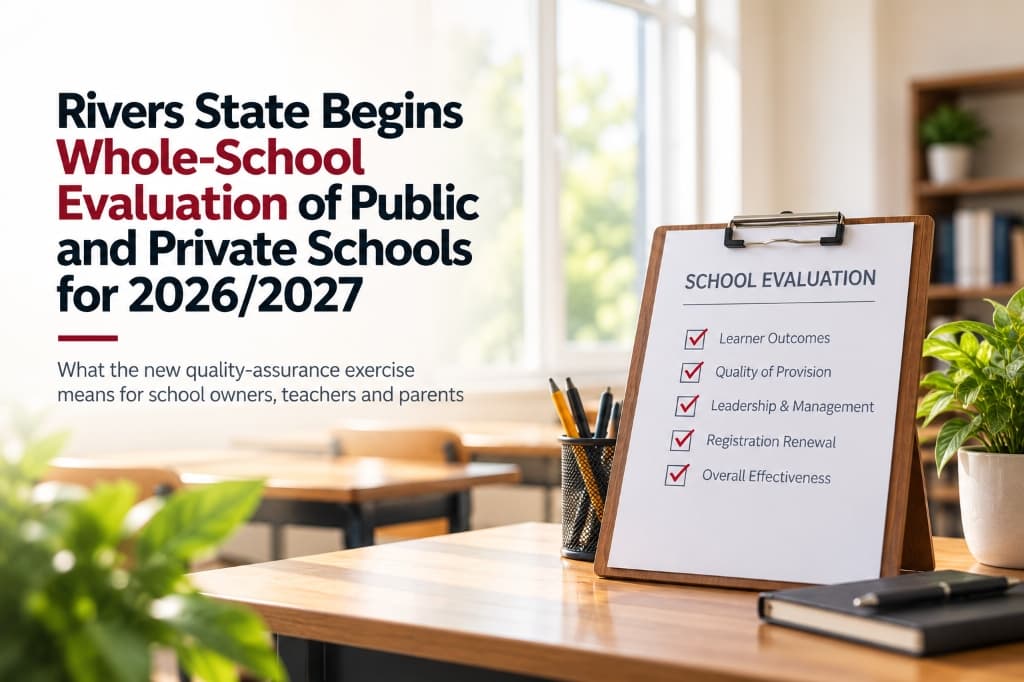
According to the Rivers State Ministry of Education, the evaluation will focus on five broad areas:
- Outcomes for learners: Academic achievement, personal development, and progress over time.
- Quality of provision: Teaching quality, learning environments, curriculum implementation, and support services.
- Impact of leadership and management: Administrative governance, safeguarding, and teacher support.
- Annual renewal of registration payments: Operational regulatory compliance and state approvals.
- Overall effectiveness of schools: Health, safety, facilities, and ethical operational standards.
"School quality is not determined by one factor. A school may have attractive facilities, but that alone does not establish educational effectiveness. Quality assurance looks broadly at how a school operates and whether its systems contribute to positive outcomes for learners."
Schools Have Been Directed to Cooperate
The Ministry has directed heads of both public and private schools to provide SEQAS evaluators with access to their schools and the facilities, records and information required for the assessment.
It also warned that appropriate penalties may be imposed on proprietors, administrators or other responsible persons who obstruct or interfere with the evaluation exercise. The Ministry has urged schools to cooperate fully with the evaluation team.
What Does This Mean for School Owners?
The announcement should encourage school owners to look beyond the visible aspects of school management:
- Is the school's documentation properly maintained?
- Are teachers adequately supported with professional development?
- Are lessons being planned and delivered effectively?
- Are learners making measurable progress?
- Are school leaders actively monitoring teaching and learning?
- Are required registrations and renewals up to date?
- Are school safeguarding policies actually being implemented?
- Are the learning environment and facilities appropriate and safe?
These questions are particularly relevant because Rivers State has already been taking steps to strengthen regulatory compliance among schools. In June, the Ministry announced plans for a statewide enforcement exercise targeting unapproved private schools and schools that fail to meet required educational standards.
What Should Teachers Pay Attention To?
For teachers, quality assurance should not be viewed simply as an inspection exercise. The quality of classroom practice is one of the most important parts of a school's effectiveness.
Teachers should therefore be able to demonstrate purposeful planning, appropriate teaching strategies, meaningful assessment and evidence that learners are progressing. A strong school is not one where teachers are simply busy; it is one where teaching activities are connected to clear learning outcomes.
And What Does This Mean for Parents?
For parents, the evaluation offers another reason to look beyond glossy school advertisements when assessing a school. While parents admire modern campuses, they ultimately want clarity:
- Are my children learning effectively?
- Are they safe and well protected?
- Are their teachers supported and qualified?
- Is the school well managed with functioning systems?
- Is the school meeting all required academic standards?
The Bigger Question: What Does “Quality School” Really Mean?
Perhaps the most important conversation arising from the exercise is one that goes beyond inspection. What should a quality school actually look like? Is it the school with the largest number of students, the most expensive facilities, or the highest fees?
Or is it a school where children are safe, teachers are equipped, leaders are accountable and learners are genuinely developing? For Rivers State's schools, the answer will ultimately be reflected in the everyday experience of children inside classrooms.
Where Can Schools Make Enquiries?
The Ministry said enquiries concerning the exercise should be directed to the Director, State Education Quality Assurance Services (SEQAS), Dr. Chinedu Wordu, at the Ministry's temporary office located at Government Girls Secondary School (GGSS), Rumuokwuta, Port Harcourt.
Port Harcourt Schools will continue to follow developments around school quality assurance, regulation and education policy in Rivers State and bring verified information to parents, teachers and school leaders.