A Child May Be Sitting in Class and Still Be Missing the Lesson: Rivers Launches School Vision Initiative
New initiative will train teachers to identify possible vision problems and support early referral across Rivers State schools.
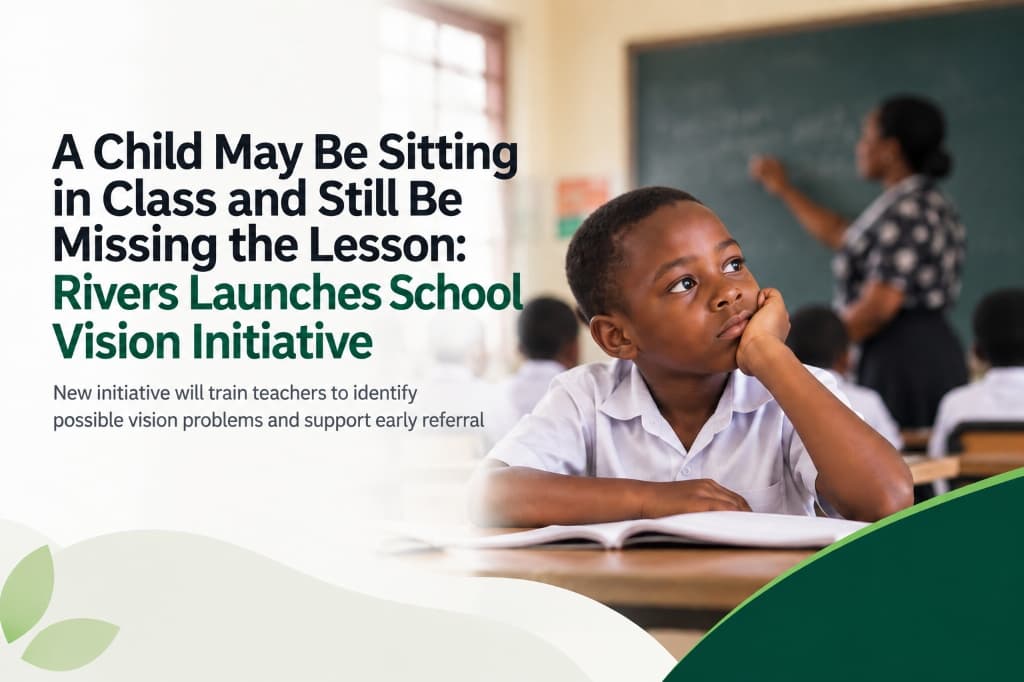
New initiative will train teachers to identify possible vision problems and support early referral.
A child sits in the classroom.
The teacher is explaining a lesson.
The child appears distracted.
Perhaps the child is struggling to read from the board. Perhaps they frequently lose their place while reading. Perhaps they avoid certain classroom activities or seem unable to concentrate.
A teacher might interpret the behaviour as poor concentration.
A parent might think the child simply needs to work harder.
But what if the problem is the child's vision?
That question is now receiving increased attention in Rivers State following the launch of the School Children Vision Detection and Referral Initiative (SCVDRI) and the institutional launch of the annual Vision Detection Training Day for Teachers (VDTDT) in Port Harcourt.
The initiative was launched on September 10 at the NULGE Consulate on Moscow Road, Port Harcourt. The Rivers State Commissioner for Education, Dr. Peters Nwagor, called for stronger collaboration between teachers, parents, health professionals, government agencies and other stakeholders to identify vision-related challenges affecting school children.
When a Vision Problem Looks Like a Learning Problem
One of the most important messages from the launch is that an undetected vision problem can sometimes affect how a child participates in the classroom.
According to the Rivers State Ministry of Education, children experiencing vision difficulties may struggle to read from the board, follow lessons or participate confidently in classroom activities.
Those difficulties can sometimes be mistaken for poor academic ability, lack of concentration or even indiscipline.
That creates a problem. If the underlying issue is never identified, a child may continue to struggle while adults around them focus on the wrong explanation.
The child may be repeatedly told to “pay attention.” They may be asked to copy more carefully. They may receive additional academic work.
But if the child cannot see clearly, more work alone may not solve the problem.
Why Teachers Are Being Brought into the Conversation
The new training initiative recognises something that happens every school day: teachers spend a significant amount of time observing children.
- They see how children read.
- They see how they copy from the board.
- They notice changes in classroom participation.
- They may notice when a child begins sitting unusually close to learning materials or avoids activities that require visual attention.
This does not mean teachers are expected to diagnose eye conditions. The Ministry specifically emphasised that teachers are not replacements for qualified eye-care professionals.
Instead, teachers can serve as an important first point of identification and referral when they notice possible warning signs.
"A teacher's role is not to say, 'Your child has an eye problem.' It is to recognise that something may be affecting the child's ability to learn and encourage appropriate professional assessment."
The Initiative Goes Beyond Eyesight
The Ministry described the programme as more than a health intervention. It also connects directly to educational equity, inclusion and learning outcomes.
If a child has an undetected barrier affecting their participation in school, identifying that barrier early can make a difference to the child's educational experience.
The Commissioner said early detection and appropriate referral are critical to improving learning outcomes and called for collaboration among teachers, parents, school administrators, eye-care professionals and development partners.
The programme's theme captures the connection: “Strengthening Learning Outcomes by Addressing Vision-Related Barriers in Schools.”
What Should Parents Be Watching For?
The launch provides an opportunity for parents to become more observant about their children's learning experiences.
A child who is struggling academically may simply need more academic support. But parents should also consider whether there could be another factor affecting the child's ability to participate fully in learning.
For example, parents can pay attention to whether their child consistently struggles with activities that require seeing clearly, whether they complain about difficulty seeing learning materials or whether teachers have noticed unusual difficulties with classroom participation.
These observations do not establish a diagnosis. They simply provide information that parents can discuss with qualified professionals when necessary.
A Classroom Problem Can Sometimes Have a Different Cause
Education is often discussed in terms of curriculum, teaching methods, textbooks, examinations and school facilities. Those things matter. But children do not enter classrooms as disembodied learners.
Their health and wellbeing can influence how effectively they participate in education. Vision is one example.
A child who cannot comfortably access what is being presented on a board, page or screen may experience the classroom differently from a child who has no such difficulty. That is why the connection between health and learning deserves more attention.
What This Means for Schools
The new initiative also gives school leaders something practical to think about. Schools may need to consider how teachers can be equipped to recognise possible barriers to learning and how referral pathways can work when concerns arise.
A good school does not necessarily need teachers to become experts in every health condition. It needs teachers and school leaders to know when something falls outside their expertise and where to seek appropriate help. That is what makes referral systems important.
The aim is not to turn classrooms into clinics. The aim is to ensure that a child who may need professional attention is not overlooked.
The Bigger Conversation About Learning
The vision initiative also raises a broader question for education in Rivers State: When a child is struggling, do we always ask the right question about why?
Sometimes the answer may be academic. Sometimes it may relate to teaching. Sometimes it may involve a child's emotional or social circumstances. And sometimes there may be a physical or health-related barrier that needs attention.
Understanding the difference matters. Because the goal of education is not simply to identify children who are struggling. It is to understand the barriers they face and, where possible, help remove them.
A Shared Responsibility
The Rivers State Ministry of Education has called on teachers, parents, school administrators, eye-care professionals and development partners to embrace the initiative.
That collaborative approach is important:
- Teachers can observe.
- Parents can share information about what they notice at home.
- Health professionals can conduct appropriate assessments and provide care.
- School leaders can help establish effective referral processes.
- Government can support policy and coordination.
No single group can address every barrier to learning alone. The launch of the SCVDRI and VDTDT therefore places a relatively simple but important idea at the centre of the education conversation: Sometimes helping a child learn begins with understanding what is preventing the child from learning comfortably in the first place.
For Port Harcourt and Rivers State schools, the effectiveness of the initiative will ultimately depend on what happens after the launch: how widely teachers are trained, whether children with concerns are appropriately referred, and whether those referrals lead to timely professional support.
Port Harcourt Schools will continue to follow initiatives that affect the health, learning and wellbeing of children across Rivers State.